

There is indeed a “toxic” climate at the International Gymnastics Federation, confirms internal report
LE TEMPS | 25.11.2025
ENGLISH TRANSLATION BELOW
The investigation, launched following revelations by Le Temps this spring, confirms serious dysfunctions within an organisation that failed to evolve at the same pace as its growth. FIG President Morinari Watanabe has promised reform.
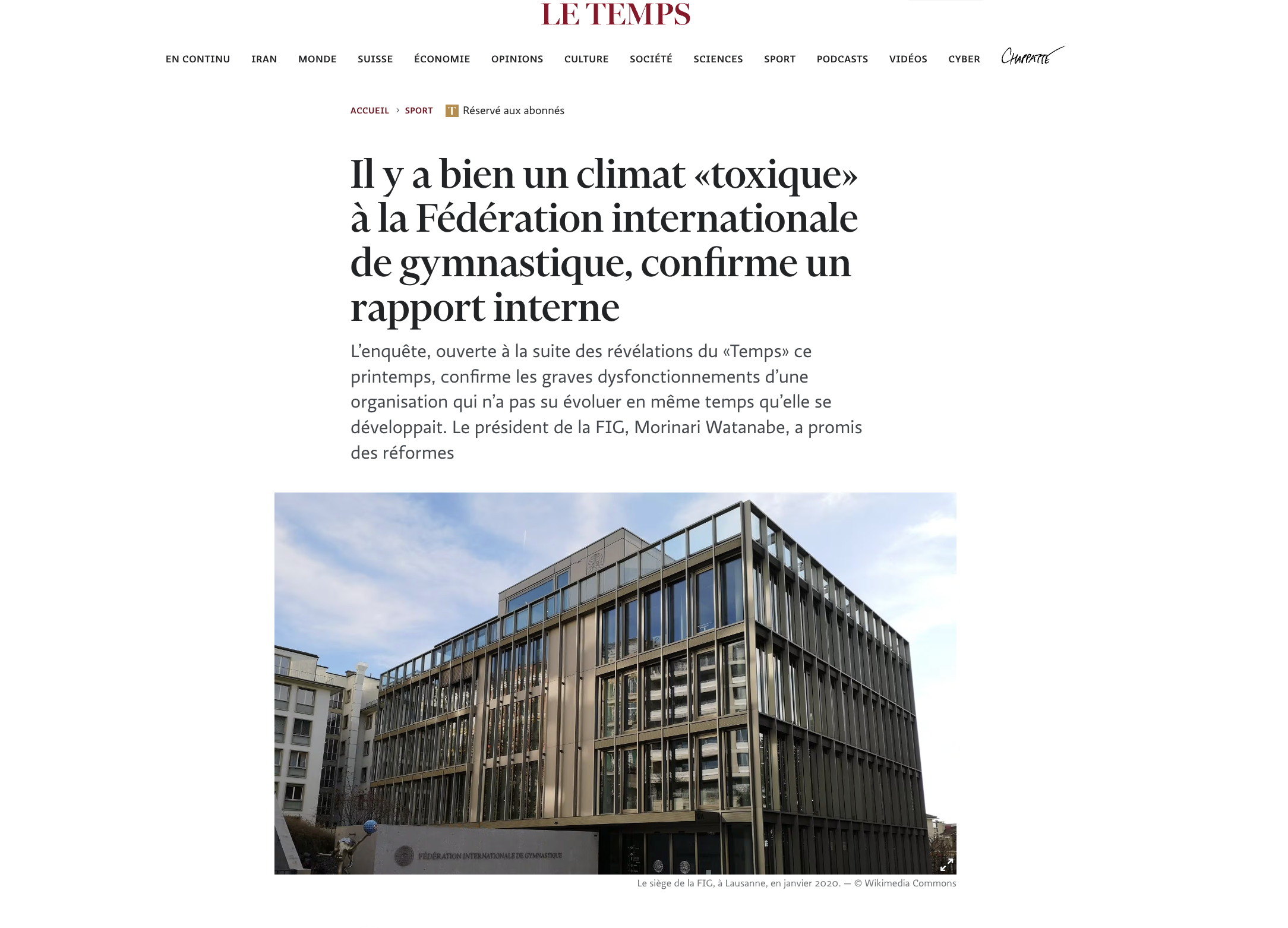
In March 2025, an investigation by Le Temps revealed serious shortcomings within the International Gymnastics Federation (FIG), based in Lausanne. Testimonies from employees and documents consulted described an organisation marked by inappropriate behaviour (homophobia and misogyny), bullying (“workplace harassment, and ineffective management of projects and finances. The organisation’s Secretary General, in post since 2019, appeared at the centre of these problems.
Following our revelations, the organisation’s executive committee - composed of representatives from different regions and the eight disciplines under FIG’s authority -requested an investigation. This was entrusted in May to the firm Essens, founded by former President of the Geneva Labour Court Sophie Schindler. The firm investigated for four months before publishing a 47-page report in early October, shared only with executive committee members, a copy of which Le Temps obtained. The objective was to “respond to allegations of harassment and abuse reported by Le Temps,” the report states.
The report is based on at least 35 interviews with employees, former employees, and a “trusted person” who carried out a preliminary audit in early 2025. It describes an organisation that underwent a chaotic transition, moving from a “small, close-knit team” operating in an “artisanal” way from its headquarters in Moutier, to a professionalised federation with international scope after its relocation to Lausanne in 2008.
A dysfunctional duo
However, internal structures did not keep pace with this evolution. Power remained concentrated in the hands of a small number of authority figures, mainly the Secretary General and the President, Japanese national Morinari Watanabe, appointed in 2016. This resulted in a “patriarchal” leadership model, the report says. Job assignments were frequently based on “personal networks” or “informal arrangements.” Roles were poorly defined, responsibilities unclear, and decision-making opaque.
The role and behaviour of the Secretary General emerged as a central factor, the authors state. He is described as showing a tendency toward micromanagement, chronic absences, favouritism, inappropriate behaviour (disparaging remarks, exclusion of employees from projects), and expressions or jokes that could be perceived as homophobic, racist, or sexist.
President Morinari Watanabe is also criticised. He is accused of “lacking a clear long-term vision,” of having approved exceptions to federation rules, and of failing to react to the Secretary General’s inappropriate behaviour.
Reforms underway
These dysfunctions created “serious psychosocial risks” within the organisation, the report concludes, describing a “toxic” climate marked by rumours, denigration, and the formation of rival factions. It notes an unusually high number of sick leaves, burnouts, resignations, and depressive episodes among employees.
This also harmed organisational performance. “The concentration of all decisions, even minor ones, in the hands of the Secretary General leads to recurring delays,” the report states. Limited attention to the commercial dimension of FIG’s work also caused it to “miss opportunities to build strategic partnerships.”
In some cases, employees were led to ignore technical regulations or cancel sanctions, raising ethical concerns, the document adds.
After the report’s publication, Morinari Watanabe announced in an email to FIG staff on October 30 that organisational reforms would be implemented by the end of the year. These include redefining job descriptions, appointing a person responsible for staff well-being, and improving human resources practices. A more fundamental restructuring will take place in 2026, he said.
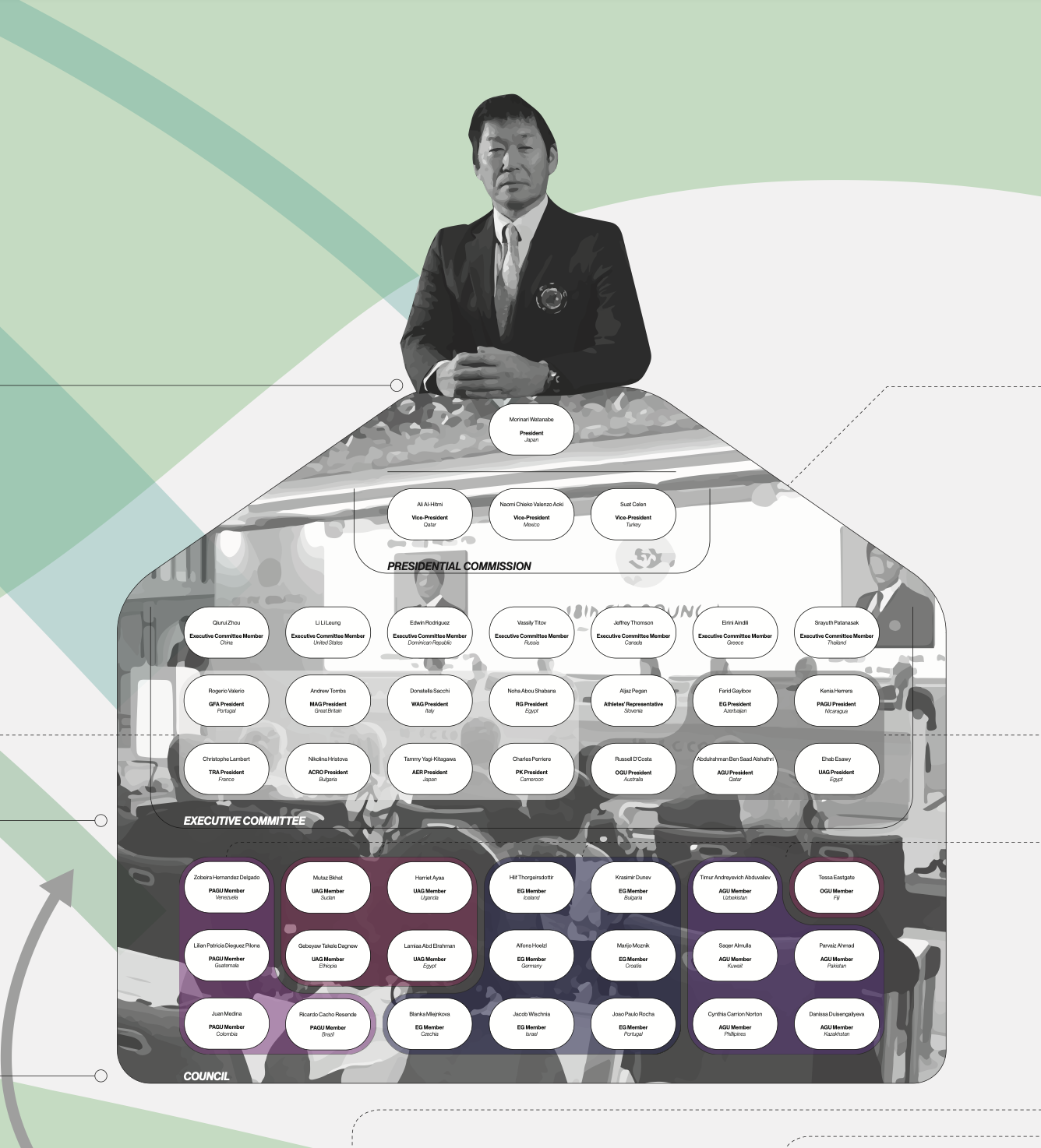
“The G4CI FIG Power Map is a massive, forensic blueprint commissioned by Gymnasts for Change International to track exactly where the money flows within the Federation of International Gymnastics (FIG), now World Gymnastics.
Standing at 4.5 meters long by 2.5 meters high, the map was deliberately built on a large scale. The most shocking detail on the map, however, is a tiny, but damning number.”
—HANNAH LILEY, CURATOR, G4CI
ORIGINAL ARTICLE [IN FRENCH]
Il y a bien un climat «toxique» à la Fédération internationale de gymnastique, confirme un rapport interne
Il y a bien un climat «toxique» à la Fédération internationale de gymnastique, confirme un rapport interne L’enquête, ouverte à la suite des révélations du «Temps» ce printemps, confirme les graves dysfonctionnements d’une organisation qui n’a pas su évoluer en même temps qu’elle se développait. Le président de la FIG, Morinari Watanabe, a promis des réformes
(FIG), sise à Lausanne. Les témoignages d’employés et les documents consultés décrivaient une organisation marquée par les comportements déplacés (homophobie et misogynie), le mobbing et une gestion inefficace des projets et des finances. Le secrétaire général de l’organisation, en poste depuis 2019, était apparu au centre de ces problèmes.
A la suite de nos révélations, le comité exécutif de l’organisation, composé des représentants des différentes régions et des huit disciplines sportives sous l’égide de la FIG, a réclamé une enquête, qui a été confiée en mai à la société Essens, fondée
par l’ex-présidente du Tribunal des prud’hommes de Genève Sophie Schindler. Celle-ci a enquêté durant quatre mois, avant de publier début octobre un rapport de 47 pages remis uniquement aux membres du comité exécutif, dont L e T em ps a pu se procurer une copie. L’objectif était de «répondre aux allégations de harcèlement et d’abus rapportés par L e T em ps», y lit-on.
Le rapport est fondé sur au moins 35 interviews avec des employés, ex-employés et une personne de confiance qui a réalisé un premier audit début 2025. Il évoque une organisation qui a effectué une transition chaotique, passant d’une «petite équipe unie» opérant de façon «artisanale» depuis son quartier général de Moutier à une fédération professionnalisée avec une envergure internationale après son déménagement à Lausanne en 2008.
Un duo dysfonctionnel
Les structures internes n’ont toutefois pas suivi cette évolution. Le pouvoir est resté concentré entre les mains d’un petit nombre de figures d’autorité, essentiellement le secrétaire général et le président, le Japonais Morinari Watanabe, nommé en 2016, débouchant sur un modèle de direction «patriarcal», estime le rapport. Les attributions de postes dependent fréquemment de «réseaux personnels» ou «d’arrangements informels». Les rôles sont mal définis, les responsabilités floues et la prise de décision opaque.
«Le rôle et le comportement du secrétaire général ont émergé comme un facteur central», estiment les auteurs du rapport. Ils lui attribuent une tendance à la micro-gestion, des absences chroniques, une tendance à favoriser certaines personnes, des comportements inappropriés (remarques désobligeantes, exclusion d’employés de certains projets) et des expressions ou blagues pouvant être perçues comme homophobes, racistes ou sexistes.
Le président, Morinari Watanabe, est lui aussi mis en cause. Il est accusé de «manquer de vision claire à long terme», d’avoir avalisé des dérogations aux règles de la fédération et d’avoir failli à réagir face aux comportements inappropriés du secrétaire général.
Des réformes en cours
Ces dysfonctionnements ont fait émerger de «graves risques psychosociaux» au sein de l’organisation, juge le rapport, évoquant un climat «toxique» marqué par les rumeurs, le dénigrement et la formation de clans rivaux. Il évoque un nombre inhabituel de congés maladie, des burn-out, des démissions en série et des épisodes dépressifs parmi les employés.
Cela a également nui à la performance de l’organisation. «La concentration de toutes les décisions, même mineures, entre les mains du secrétaire général engendre des retards récurrents», estime le rapport. L’attention limitée apportée à la dimension commerciale du travail de la FIG l’a en outre amenée à «rater des opportunités pour nouer des partenariats stratégiques».
Dans certains cas, des employés ont été amenés à ignorer des règlements techniques ou à annuler des sanctions, soulevant des questions éthiques, poursuit le document.
Après la publication du rapport, Morinari Watanabe a annoncé le 30 octobre dans un e-mail au personnel de la FIG des réformes organisationnelles qui seront mises en œuvre d’ici à la fin de l’année, dont la redéfinition du cahier des charges des employés, la nomination d’une personne chargée de leur bien-être et l’amélioration des ressources humaines. Une réorganisation plus fondamentale aura lieu en 2026, précise-t-il.