

Frankfurter Allgemeine Zeitung: Interview with Claire Heafford
FRANKFURTER ALLGEMEINE ZEITUNG | 07.04.2026
SANDRA SCHMIDT
ENGLISH TRANSLATION BELOW
Reading time: 8 Min.
Claire Heafford is the executive director of the only advocacy group for abuse victims in gymnastics. In this interview, she talks about dependency, violence, and how it might be possible to achieve top performances without harming athletes.
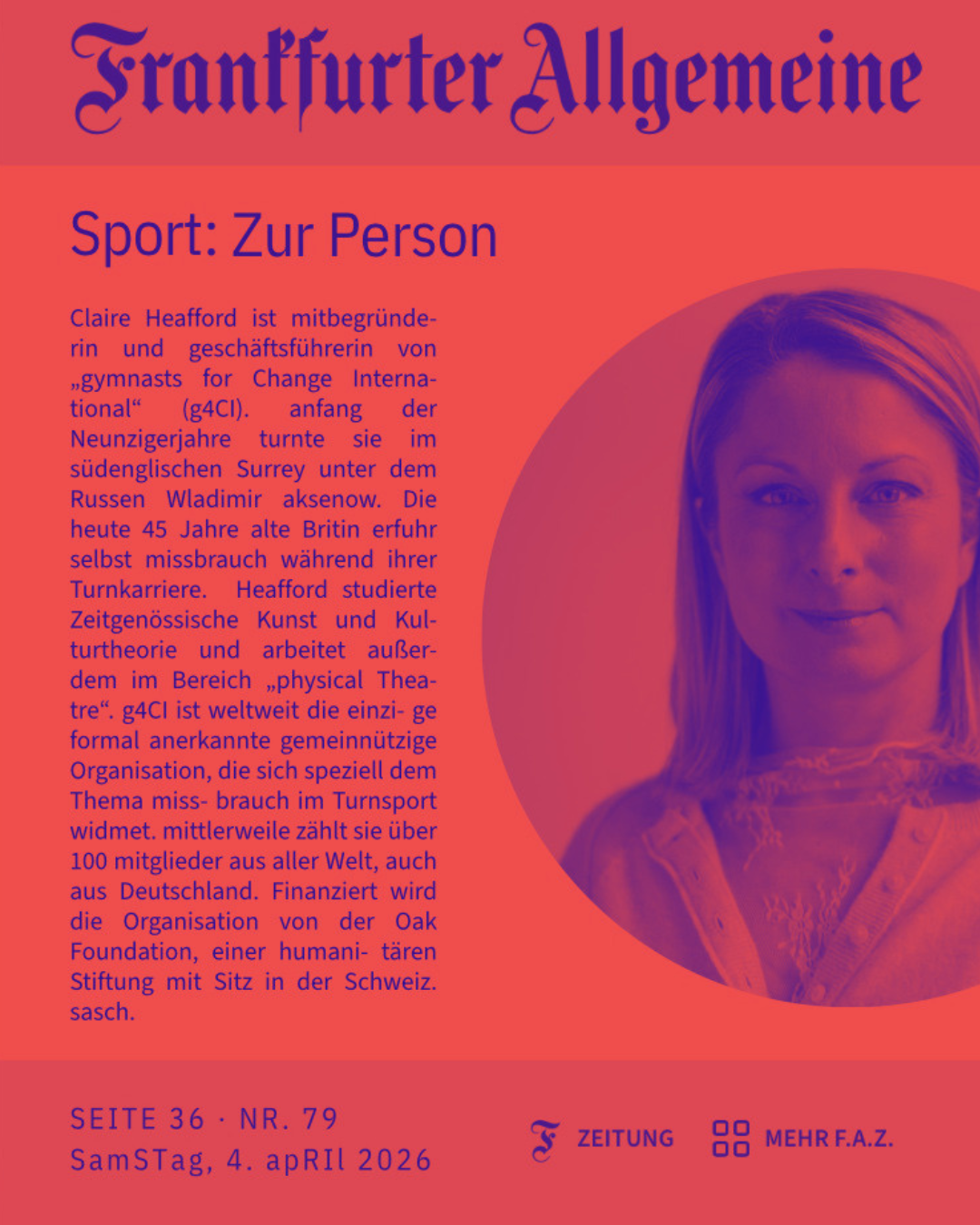
Claire Heafford is co-founder and executive director of Gymnasts for Change International (G4CI). In the early 1990s, she trained as a gymnast in Surrey, southern England, under the Russian coach Vladimir Aksenov. The now 45-year-old Briton experienced abuse herself during her gymnastics career. She studied contemporary art and cultural theory, and also works in physical theatre.
G4CI is the world’s only formally recognised nonprofit organisation dedicated specifically to addressing abuse in gymnastics. It now has over 100 members worldwide, including in Germany, and is funded by the Oak Foundation, a humanitarian organisation based in Switzerland.
You founded Gymnasts for Change International (G4CI) to raise awareness about abuse, protect athletes, and hold perpetrators accountable. How did this come about?
I saw the documentary Athlete A in 2020, just a few days after its release, and immediately felt: now is the time! I had wanted to speak about the abuse I experienced in my own gymnastics career for about fifteen years, but I didn’t know how. Athlete A gave me the language to articulate what I had gone through. With the support of a lawyer, I then initiated a class-action civil suit on behalf of around forty people against our federation, British Gymnastics.
How is G4CI structured organisationally?
In the early years, we all worked without pay. I coordinated media appearances of many courageous survivors via a WhatsApp group. Public pressure helped initiate the Whyte Review, an independent investigation into systemic abuse in British gymnastics. By now, we are a registered charity with 14 part-time employees. During this transformation, we developed new guidelines for trauma-informed practice.
What does that mean?
We extensively studied best practices for trauma-informed advocacy. In the context of sports, this is largely uncharted territory. Trauma and athletes’ human rights have rarely been addressed in sport. Even the lawyers we work with had limited experience in drafting documents that take into account traumatic experiences.
Why is such an organisation important?
We need sustained and coordinated work to ensure strong athlete representation so that our stories can no longer be dismissed. It is a fact that female gymnasts have been reporting abusive training practices for around 40 years, but they were always silenced. Since gymnasts first spoke out collectively in 2020, it has been essential to keep up the pressure, because the work towards real reform has only just begun.
The “Whyte Review” documented abuse in gymnastics between 2008 and 2020 in a 400-page report. How important is this study?
It made clear that things have to change. However, it did not go far enough. Its purpose was mainly to reflect the perspectives of gymnasts, not to pass judgments on individual coaches.
What were the reactions?
Interestingly, people within the federation were far less shocked than those outside gymnastics. Other sports noticed structural similarities and parallels to abuse cases. So, the study influenced debates across British sport more broadly. Regarding financial support, suspending UK Sport funding could have been an option, but instead BG actually received additional funding to support reform efforts.
How do you assess the consequences?
It is undeniable that British Gymnastics has done a great deal over the past three years to change the sport, for example in coach education. That is welcome. However, much clearer definitions of abuse are needed to prevent past mistakes from being repeated.
The newly established “independent complaints process” is unfair. It deals with allegations against specific coaches, who are allowed legal representation, while gymnasts and witnesses are not. The process is also extremely slow and lacks transparency. And there is a complete lack of empathy and understanding for those affected.
Were sanctions imposed?
To our knowledge, allegations of emotional and physical abuse were confirmed in more than 20 cases, including against some national team coaches. Warnings and further training requirements were issued.
As survivors of abuse in gymnastics, we are deeply disappointed with these sanctions. Suspensions or exclusions must also be possible and should be visible to the public, sending a clear message to coaches who continue questionable practices.
However, the results were not published. This means parents do not know whether allegations exist against their children’s coach.

“There is no reason why athletes cannot succeed while optimising their performance in a healthy way. I firmly believe that top performances are possible without harming athletes. We can have a sport that respects human rights and protects athletes.”
— CLAIRE HEAFFORD, CO-FOUNDER & CEO, G4CI
After the “Whyte Review,” the “Reform 25” initiative was launched. How satisfied are you with it?
In 2020, G4CI set out exactly 78 demands and compared them with BG’s measures in 2025. I can say I am about 36 percent satisfied.
Roughly one third of our demands have been implemented, one third are in progress, and one third have not yet been addressed. Gymnasts are expected to give 100 percent in training - I would like to see the same standard applied to protecting athletes.
What is still lacking?
From the emotional perspective of someone who has experienced abuse, it is difficult to believe that these shortcomings are not intentional or malicious. But over time, I have come to believe this is about a deep cultural shift—and we are only at the beginning.
Strategic litigation is the third pillar of G4CI’s work. Proceedings in German courts have been difficult so far. What is your experience?
Most abuse cases involving girls and women in sport fall below the threshold of criminal law. They involve physical abuse without direct contact—such as training through injuries—or coercive control and emotional manipulation.
These forms of abuse cause severe psychological harm but are often not recognized. Civil class-action lawsuits are extremely important because insurers now exert pressure on the federation and hold it accountable. Compensation payments have been relatively low, but long-term systemic change is the goal.
Another difficult issue in Germany is dismissing coaches. How is this handled in the UK?
It is extremely difficult to dismiss coaches. Abuse is often confirmed in hearings, but then legal standards are applied that do not account for these forms of abuse. As a result, coaches are allowed to continue working.
This is a major injustice. A large part of our work involves challenging such decisions. Recognising coercive control as abuse is essential for protecting children in sport.
There is also a structural issue: British Gymnastics represents both athletes and coaches, creating a conflict of interest that often works against dismissing coaches.
Some argue that certain gymnasts worked well with coaches facing serious allegations. Does that trivialise the issue?
It is complex. For me, it resembles a Faustian bargain. As an elite athlete, you make a pact with the devil: you reach the Olympics, are seen as superhuman, but effectively give up your human rights.
Many athletes get caught in a cycle. Olympic status can benefit them for life. Why would they criticise the system that enabled it? This also normalises training practices that should be investigated.
Is abuse a fundamental problem in elite sport?
All sports have issues with athletes’ rights, but how they manifest depends on the culture of the sport.
In gymnastics—artistic, rhythmic, and acrobatic—there is a particular problem affecting women and girls, because misogynistic attitudes are deeply embedded in the structures. In the UK, 89 percent of gymnasts are girls under twelve.
This makes it both a child protection issue and a problem of violence against women and girls.
Physical and emotional abuse is often committed by female coaches. Does that surprise you?
Unfortunately not. It relates to the environment in which these coaches were trained.
In the 1970s and 1980s, many male coaches in the Soviet Union moved into women’s gymnastics. They pushed for more acrobatics and younger bodies, which are easier to manage physically, and displaced female coaches.
These women then had to justify their place. Many adopted harsh and manipulative methods to prove they could deliver results.
Much has been written about the Karolyi system after “Athlete A.” What about coaches from the former Soviet Union who moved west?
They are comparable in terms of structural conditions. In state-run systems, success brought national prestige and significant social and economic advantages.
Families saw it as an honor when a child entered a training center. Personal sacrifice was expected and valued.
British coaches were even sent to Romania and Moscow to learn these methods. As a result, coaches like Adrian Stan and Vladimir Aksenov—and their training methods—shaped gymnastics culture in many Western countries.
How important would a public list of banned coaches be, like in the USA?
Essential. Because transparency is essential.
It would show that safeguarding standards are being enforced. Currently, we only have a list of coaches banned in the past. Despite many investigations, very few new names have been added.
In contrast, UK Athletics publishes all sanctions, hearing outcomes, and details on its website.
What do you think about raising the minimum age for female gymnasts?
I strongly support it. Currently, female gymnasts can compete at World Championships and the Olympics in the year they turn 16, while men must be 18. This encourages pushing children toward elite performance before they are physically and psychologically ready. The International Gymnastics Federation and the International Olympic Committee must acknowledge this issue.
What needs to change in the long term?
Federations must establish standards for good coaching behavior, as British Gymnastics has begun to do.
They must educate everyone in the system—coaches and athletes—and encourage athletes to report when standards are not met. They must ensure athletes are heard and empowered.
This would create a healthier system where performance and personal responsibility go hand in hand.
What is achievable?
We can have a sport that respects human rights and protects athletes.
There is no reason why athletes cannot succeed while optimising their performance in a healthy way. Brutality and avoidable suffering are not necessary.
I firmly believe that top performances are possible without harming athletes.